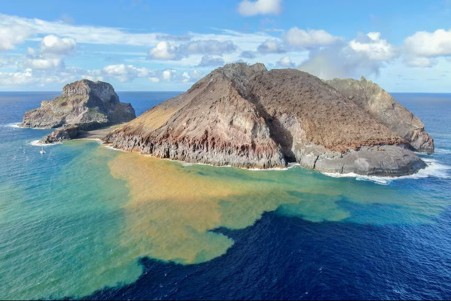
On 31 August 2026, the Republic of Vanuatu filed an Application instituting proceedings against the French Republic before the International Court of Justice (“ICJ” or the “Court”), requesting that the Court affirm Vanuatu’s sovereignty over two uninhabited volcanic islands in the South Pacific, Matthew (Umaenupne) and Hunter (Umaeneg/Leka), and establish a single maritime boundary between the exclusive economic zones and continental shelves of Vanuatu and France (with respect to New Caledonia).
Vanuatu, formerly the New Hebrides, was jointly administered by France and the United Kingdom until its independence in 1980. Since then, it has claimed sovereignty over the islands as successor to that territory. France, which administers the islands as part of New Caledonia, maintains its sovereignty over them and considers that they generate an exclusive economic zone of approximately 350,000 square kilometres. In July 2026, after several rounds of bilateral negotiations, Vanuatu announced that the talks had reached an impasse.
Vanuatu seeks to found the Court’s jurisdiction on Article 38, paragraph 5, of the Rules of Court, a mechanism known as forum prorogatum, which permits a State to file an Application against another State that has not accepted the Court’s jurisdiction and to invite that State to consent to it for the purposes of the case. France withdrew its declaration accepting the compulsory jurisdiction of the ICJ under Article 36(2) of the Statute of the Court in 1974, in the context of the Nuclear Tests cases. The Court therefore transmitted Vanuatu’s Application to France but noted that no action would be taken “unless and until France consents to the Court’s jurisdiction in the case”.
As a result, the case has not been entered in the Court’s General List. As the Court explained in Djibouti v. France (2008), the invited State is free to accept or decline jurisdiction, or not to respond at all. There is no deadline for France to respond. France has accepted jurisdiction in this way twice before, in Republic of the Congo v. France and in Djibouti v. France itself. After the Application was filed, France publicly reaffirmed its sovereignty over the islands. Vanuatu’s representatives have said that, if France does not consent, Vanuatu may seek an advisory opinion through the United Nations General Assembly.
In October 2026, Vanuatu also initiated arbitration proceedings against France under the United Nations Convention on the Law of the Sea (“UNCLOS” or the “Convention”). Unlike the Application before the Court, these proceedings do not seek a ruling on sovereignty or on the delimitation of a boundary. Instead, Vanuatu asks the tribunal to determine the legal characterisation of these islands and of a number of other reefs and atolls between Vanuatu and New Caledonia, and its consequences for maritime entitlements. France considers that these features entitle it to a large maritime area. Vanuatu argues that they are “rocks” that cannot sustain human habitation or economic life of their own, within the meaning of Article 121(3) of UNCLOS, or low-tide elevations, and that they therefore generate no exclusive economic zone or continental shelf.
The arbitration may raise its own jurisdictional questions. UNCLOS tribunals can only decide disputes concerning the interpretation or application of the Convention and have so far declined to rule on contested sovereignty over land territory, as illustrated by Chagos Marine Protected Area (2015). France has also made a declaration under Article 298 of UNCLOS excluding maritime delimitation disputes from the compulsory procedures under section 2 of Part XV. Vanuatu’s claim, framed around the status of maritime features, follows the approach of South China Sea (2016), where the tribunal ruled on the status of features without deciding which State held sovereignty over them. The tribunal may therefore have to decide whether the status of the islands can be determined without implicitly addressing sovereignty or delimitation.
For further information, please contact info@volterrafietta.com.