Published on 20 May 2026 in Client Alerts
On 5 May 2026, Thailand announced a unilateral termination of its Memorandum of Understanding dated 18 June 2001 (“Agreement”) with Cambodia pertaining to their joint exploration rights in the area of their overlapping Maritime Claims to the Continental Shelf.
The 25-year-old Agreement sought to accelerate negotiations of a Joint Development Treaty to streamline joint exploitation of the hydrocarbon resources in the territorial sea, continental shelf and exclusive economic zone in the Gulf of Thailand. Thailand’s Prime Minister Anutin Charnvirakul attributed this impending termination to lack of progress in achieving the objectives of the Agreement, stating that, “[c]ancelling the deal is not related to the border conflict with Cambodia, but part of my policy. It has been 25 years and there has been no progress”.
Cambodia has expressed regret over the severed maritime pact. Cambodia’s Foreign Minister Prak Sokhonn remarked that the State has no option but to settle the boundary dispute with Thailand legally under the 1982 United Nations Convention on the Law of the Sea (“UNCLOS”). He stated, “Cambodia’s decision to pursue compulsory conciliation under UNCLOS reaffirms its commitment to resolving maritime disputes peacefully and in accordance with international law”.
Thailand and Cambodia have both excluded from the compulsory and binding dispute settlement mechanism in Part XV of UNCLOS, any disputes concerning the interpretation or application of Articles 15, 74 and 83 relating to sea boundary delimitations or those involving historic bays or titles. However, pursuant to Article 298, such exclusion is subject to the proviso that, if disputing parties fail to reach an agreement within a reasonable period of time, one of them can oblige the other to submit the dispute to conciliation under Annex V, section 2. This is what Cambodia has now done.
As a context to this recent development, in relation to their land boundary both countries engaged in armed hostilities in 2025 over competing territorial claims. Cambodia officially approached the International Court of Justice to resolve its enduring border dispute with Thailand.
Volterra Fietta is the leading public international law firm in the world. It is ranked in Band 1 by Legal 500 and Chambers and Partners in Public International Law.
“Our government sent a delegation on a road-trip to France, Belgium, The Netherlands, the United Kingdom and the United States of America to consult government lawyers, international law professors and private lawyers trusted by the government. We asked them whom we should hire as external lawyers for our upcoming maritime boundary negotiation and litigation. They each said: if you want the best, then there is only Volterra Fietta.”
For further information, please contact info@volterrafietta.com.
Volterra Fietta’s intensive hearing schedule for 2026 has continued apace. In July 2026, a team from the firm, led by Robert Volterra, Ahmed Abdel-Hakam and Florentine Vos, represented the Republic of Croatia at a hearing in the Addiko Bank AG and Addiko Bank d.d. v Republic of Croatia (ICSID Case No ARB/17/37).
Learn more

From 8 to 10 July 2026, Canadian Prime Minister Mark Carney and Saudi Crown Prince and Prime Minister Mohammed bin Salman bin Abdulaziz Al Saud met in Jeddah to discuss bilateral relations and regional developments. The visit yielded the signing of 13 new Memorandum of Understandings (MOUs) and commercial agreements across trade, investment, energy, mining and natural resources, technology, education, health, people-to-people ties, and defence.
Learn more

On 13 July 2026, the United Kingdom and the Swiss Confederation announced the conclusion of negotiations on an enhanced free trade agreement (“FTA”). This followed ten rounds of negotiations to modernise the two States’ bilateral framework which were launched in 2023. The Parties have indicated that they anticipate the final technical edits to be finalised
Learn more
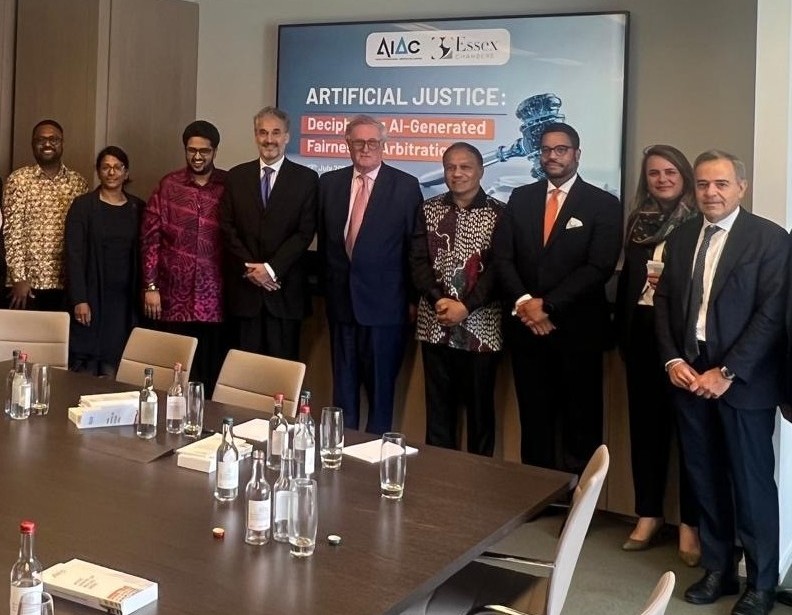
On 17 July 2026, Volterra Fietta partner Robert G Volterra spoke at the Asia International Arbitration Centre London Roundtable on “Artificial Justice: Deciphering AI-Generated Fairness in Arbitration”. Robert discussed the growing use of AI in legal practice and dispute resolution, focusing on the limits of current AI tools and the risks associated with their use.
Learn more